
Our Waste & Our Solutions
Our waste, including any residues from production, processing, or use.
At our disposal
1. Household trash collection and recycling:
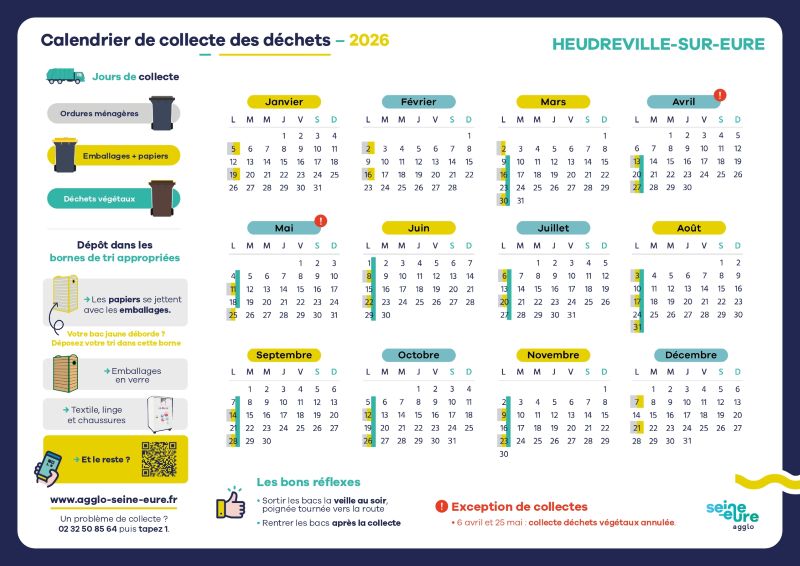
AggloSeineEure 2026 Collection Schedules_Heudreuville-sur-Eure. Please put out your bins the night before, with the handle facing the street.
You may receive requests for bins due to a new allocation, or a broken, stolen, or missing bin Request one online here.
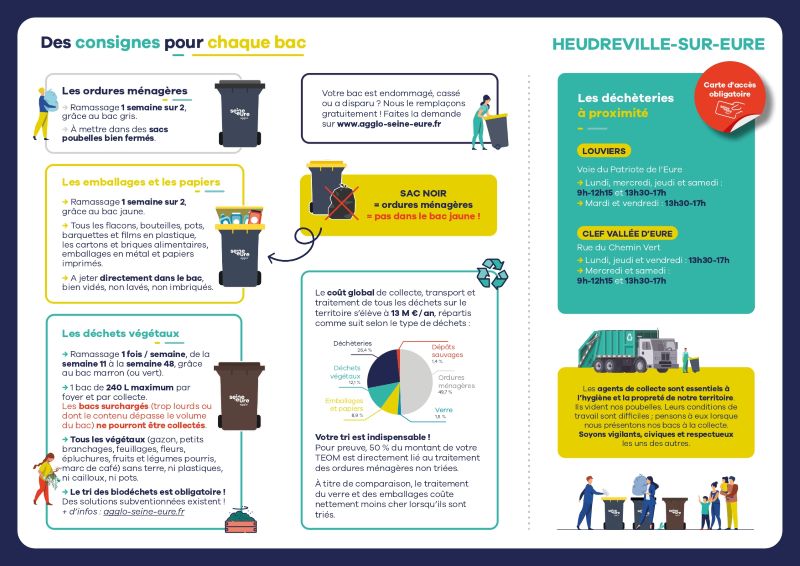
2-Clef-Vallée-d’Eure Recycling Center
Rue du Chemin Vert
La-Croix-Saint-Leufroy
27940 CLEF VALLEE D’EURE Tel: 06.77.56.17.50
The recycling center card is required; it allows you to be quickly identified by the recycling center staff.
3-Glass Collection
Recyclable glass should be placed in the recycling bins provided throughout the town.
Take the road from Pacy toward the train station and leave the village via the D155 toward Evreux.
4-Textile Collection
A collection bin for textiles, clothing, and shoes is available through the Le Relais association on Route de Pacy, heading toward the train station. You can drop off your used clothing there, and it will be recycled.
5-Recycling Bottle Caps
A collection bin for bottle caps and lids, provided by the Normandy-based organization BOUCHONS 276, is available in the town hall’s waiting room. You can drop off your caps from water, milk, soda, fruit juice, ketchup, mayonnaise, toiletries, and cleaning products, as well as lids from chocolate powder, coffee, and spreads—in short, all your plastic caps and lids.
The objectives of this association are, on the one hand, sustainable development and, on the other hand, the provision of assistance in the form of funding for the adaptation of facilities and vehicles and the purchase of specialized equipment for people with disabilities in Normandy.
Recycling
Paper and Cardboard

One tree produces about 440 kg of paper. Newspapers read for an average of 20 minutes require the felling of trees that are several decades old. Forests are the Earth’s lungs, and it is important to protect them. Recycling cardboard helps preserve nature and the air we breathe.
Paper cannot be recycled indefinitely. The very nature of wood fiber presents a significant limitation. The fibers deteriorate with each processing step and become shorter. They can be recycled about ten times.
By recycling 1 metric ton of paper, I save:
– Between 1.5 and 2.5 metric tons of wood,
– The energy consumption of one person in one year,
– The water consumption of one person in six months,
Glass

Glass is produced by mixing sand, sodium carbonate, and lime and heating the mixture to temperatures around 1,500°C. Using recycled glass reduces energy consumption by more than 25%. Glass is 100% recyclable without any loss of quality or quantity, regardless of its color.
By recycling 1 metric ton of glass, I save:
– 700 kg of sand
– 2 months’ worth of energy consumption for one person
– one person’s water consumption over 8 days.
Steel

The scrap metal trade is the oldest recycling network in the world. Steel can be recycled without any loss of quality. To produce new raw material, the packaging collected by the network is crushed and melted down. Recycled aluminum requires only 5% of the energy needed to produce primary aluminum.
By recycling 1 metric ton of metal, I save:
– 1 metric ton of iron ore – 0.5 metric tons of coke – 120 kg of crude oil.
– 9 months’ worth of energy consumption for one person.
– 6 months’ worth of water consumption for one person.
Plastic

Some plastics are more recyclable than others. A triangle made up of three arrows and a number from 1 to 7 (usually on the bottom of the container) indicates the type of plastic. This number identifies the type of plastic used to make the container. Feel free to call your local municipality to find out what types of plastic you can put in your recycling bin.
By recycling 1 metric ton of PET (polyethylene terephthalate), I save
–800 kg of oil
–400 kg of natural gas
–1 year’s worth of energy consumption for 2 residents
–one resident’s water consumption over 2 months
Our Impact
Humans shamelessly dump their trash into the natural world that gave them life. Not all waste has the same ecological impact, and some types have a more devastating effect on the environment than others.
- 2 weeks Once discarded, an apple core takes about 15 days to decompose completely. This rapid decomposition can attract scavengers, such as rats.
- About 1 month The time it takes for paper towels, paper bags, newspapers, or cloth to decompose
- Banana peelstake 6 weeks to decompose; they break down in about a month and a half. If the weather is cool, the fruit may take several months to decompose. Banana peels are designed to protect the inside of the fruit and are made of cellulose, the same material used in cellophane packaging.
- 6 months Paperback books and cotton clothing take about 6 months to decompose in nature.
- 1 year The fleece of sheep—as well as light woolen clothing, such as sweaters and socks—takes about a year to deteriorate.
- 2 years Orange peels , plywood (a material made from glued-together wood panels), and cigarette butts take about 2 years to decompose.
- 10 to 20 years The time it takes for plastic bags to degrade is estimated to be a few decades; some studies estimate that they could have a lifespan of about 1,000 years.
- 30 to 40 years : Nylon items , such as tights and anoraks, as well as rugs and disposable diapers, are estimated to take between 30 and 40 years to break down in the natural environment.
- 50 years Cans, car tires, athletic shoes, and even leather have a lifespan nearly equal to that of a human being, as it is around 50 years.
- 75 to 80 years: While a bag of potato chips takes an average of 75 to 80 years to completely decompose in nature, it is made from “metallized” plastic film, which increases the time required for biodegradation.
- 100 years Plastic rings from beer packs—which are particularly harmful to animals, as they often get their heads stuck in them or choke on them—are estimated to take about 100 years to break down, though this timeframe can extend up to 450 years.
- About 200 years Aluminum cans take at least 200 years to break down in the natural environment.
- 500 years. Half a century. That’s how long it takes for plastic bottles to be completely broken down by nature.
- 2 million years Glass containers, jars, and bottles generally take 1 to 2 million years to degrade.
- A very, very long time Even though their metal casings eventually break down in the environment, batteries contain chemicals—such as zinc chloride, lead, mercury, and cadmium—that persist in the soil. Because of their high toxicity, these batteries must be recycled to prevent them from harming the environment.
